
The chair, the fire, and the work that happens here
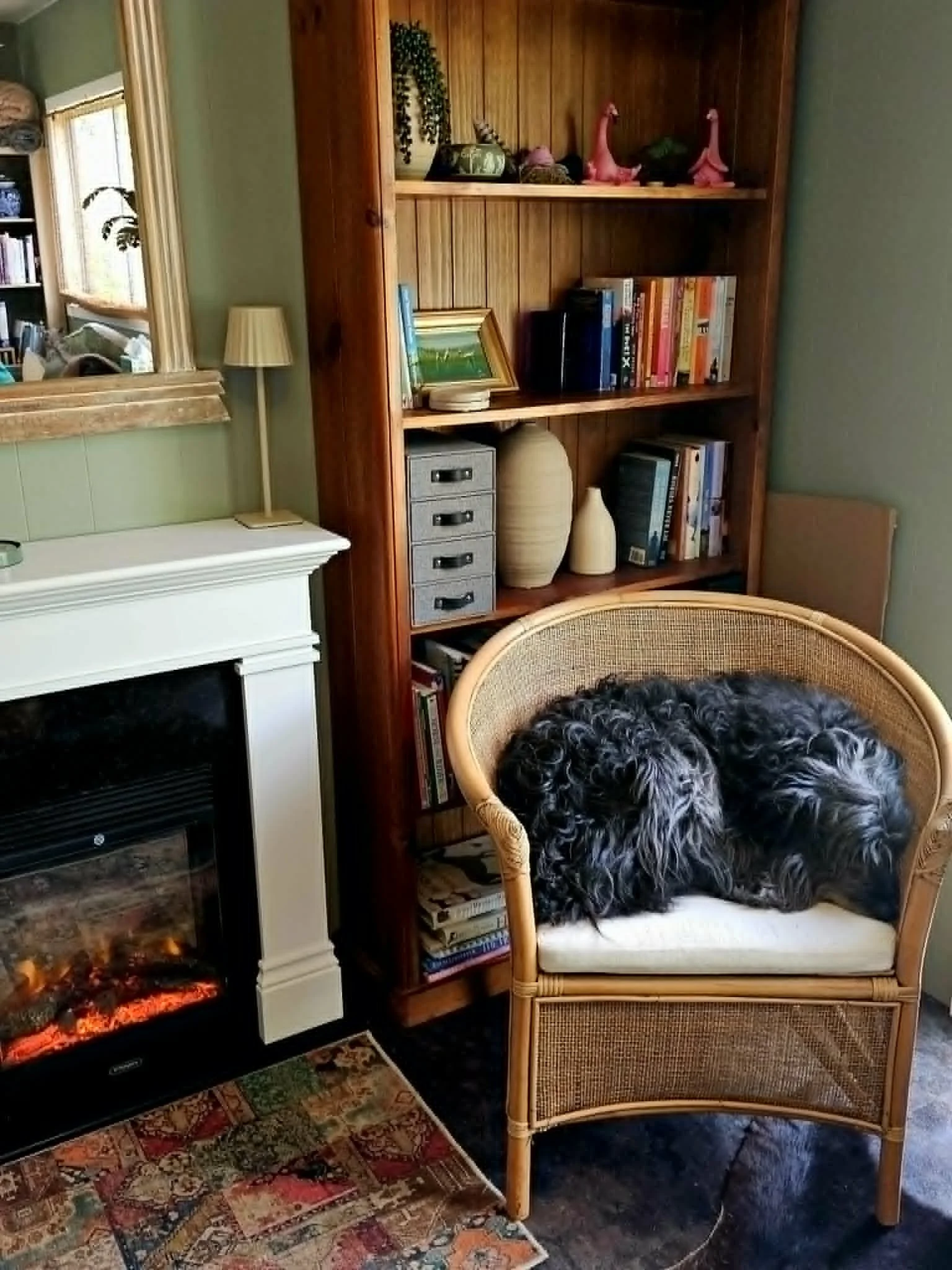
A medium grey scruffy dog curled up asleep in a cane armchair beside a glowing fireplace, with a timber bookshelf and sage green walls in the background. The counselling room at Able Stables, Sandbeck, Pipers River, Tasmania.
Yesterday it was Goo-Bear's chair. Today, given the temperature outside, I expect it will be again.
There is something worth saying about that image. A warm room, a fire, a bookshelf, a dog who has made an executive decision about where he belongs. It looks, I think, like somewhere a person might feel safe enough to do something difficult.
That's not accidental.
Growth, real growth, the kind that lasts, doesn't happen in comfort alone. It happens when comfort and challenge exist in the same place at the same time. The fire and the work. The familiar and the confronting. The dog in the chair and the conversation that follows.
At Sandbeck, the environment itself asks something of the people who come here. The animals need attending to. The seasons set the rhythm. The community, my family, the people who work the land, the other clients, has its own life, its own pace, its own quiet requirements. People arrive and, gently and in their own time and supported at every step, find where they belong within it.
What the research tells us
There is a growing and credible body of evidence behind what happens in environments like this one. Research into care farming identifies personal growth as one of its most consistent findings, noting that the opportunity to build skills and gain self-efficacy through real, purposeful activity brings a sense of hopefulness that is vital to mental health recovery. Importantly, that self-efficacy, the belief in one's own capacity to manage and do things, is not borrowed from a workbook. It is earned, in real time, in a real place.
A review of Norwegian care farm studies reported improvements across depression, anxiety, perceived stress, positive affect and self-efficacy among participants, with qualitative accounts describing improved coping ability, increased social support, and a deep appreciation for the activity itself. Qualitative research into recovery on care farms found that participants experienced these settings as open, real-life environments where they could exercise genuine responsibility and connect with people, and that this, more than any single activity, was the driver of progress.
What happens next is something to witness
Research into nature-based therapy describes the process well: positive emotional experiences in natural environments promote changes in thinking and cognitive systems, which then bring about changes in behaviour and restoration of interpersonal relationships and social life. In plain terms, what people discover here about themselves does not stay here. Confidence transfers. Steadiness holds in other rooms, other relationships, other challenges.
Studies examining nature-based programs show statistically significant increases in interpersonal relationship skills including openness, communication, sensitivity and credibility among participants, and a scoping review of nature-based interventions found that these outcomes are largely maintained well after treatment ends. The ripple tends to travel further than anyone expects.
The clients who find their way here and do the work, and it is work, are quietly extraordinary. They show up. They engage with something real. They allow themselves to be changed by it. And they carry that change outward into their lives in ways that are sometimes difficult to put into words, and sometimes very easy.
Why places like this are rare
This is also why environments like Sandbeck are rare, and why they require careful stewardship. The animals, the land, the community, and the work all have integrity of their own. That integrity is not incidental to the therapy. It is the therapy.
For those who are ready to be part of something like this, there is very little else quite like it.
And to the clinicians, planners and professionals who have made the drive out, walked the property, and taken the time to understand what happens here, thank you. Good science has always begun with the willingness to look at something properly. Sandbeck is glad to be looked at.
Now, if you'll excuse me, there are weekend sessions to get to. Curious to see what this one brings.
